Recap of US Markets
STOCKS
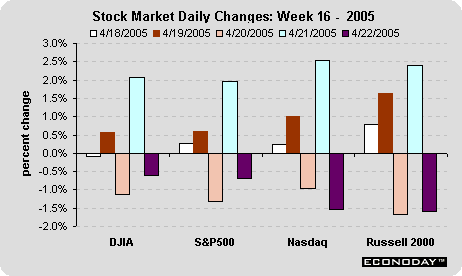
The equity market saw very good days this week - along with very bad days! Indeed, Thursday's gain in the major indexes was among the largest in a couple of years. But before one gets overly excited, the market suffered some significantly large declines as well. The bulk of this week's movement stemmed from optimistic as well as pessimistic earnings coming from a variety of companies. Inflation news did hurt the market on Wednesday, but most of the focus was earnings-based. Despite the sharp fluctuations in both directions, the Friday-to-Friday change was slightly positive.
BONDS
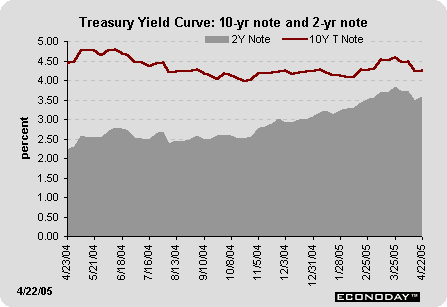
Yields were all over the board this week with large gains and equally large declines. After all was said and done, yields ended up not too different from the previous week. The 10-year Treasury note yield was nearly on par with last week's rate, although the 2-year note yield inched up a couple of basis points. It appears that bond investors are much less worried about Fed rate hikes these days because economic news has been more anemic. However, Fed Governor Donald Kohn indicated in a speech on Friday that the Fed is intent on removing "unusual" policy accommodation. Thus, the Fed is likely to continue to raise the Fed funds rate target at the next couple of meetings.
Markets at a Glance
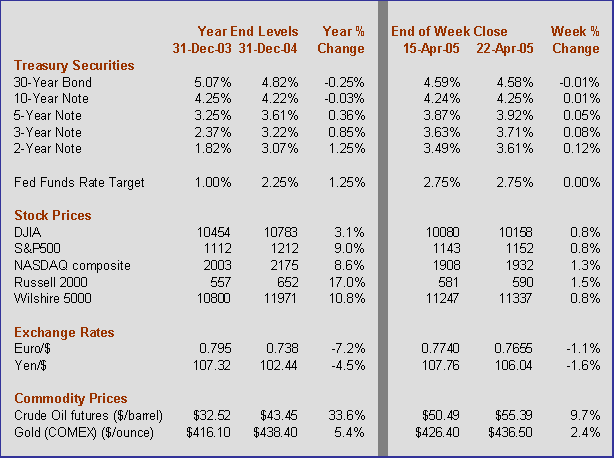
Weekly percent change column reflects percent changes for all components except interest rates. Interest rate changes are reflected in simple differences.
The Economy
Inflation spikes!
March PPI jumps 0.7 percent
The producer price index jumped 0.7 percent in March after posting smaller gains in the two previous months. To no one's surprise, a 3.3 percent spurt in energy prices was the primary culprit behind the hike. The March rise in energy prices was more than twice as strong as February's 1.4 percent gain and puts the year-over-year rise at 15.3 percent. The energy price index in March stood roughly 50 percent above the index level for February 2002, the low point in this cycle. The gasoline price index is rising much more rapidly with prices roughly double what they were at the low a couple of years ago.
Excluding food and energy prices, the PPI inched up 0.1 percent for the second straight month as motor vehicle prices and computer prices fell, helping to dampen the index. Although the increases of the past two months were mild, there is no question that the overall trend in the core PPI has risen in the past 12 months over the previous 12 months.
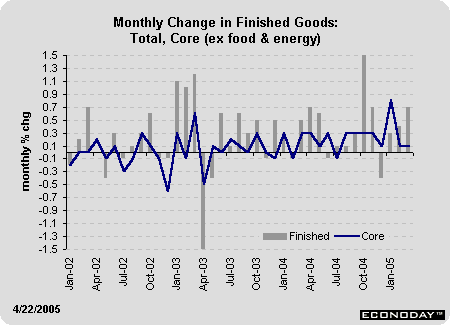
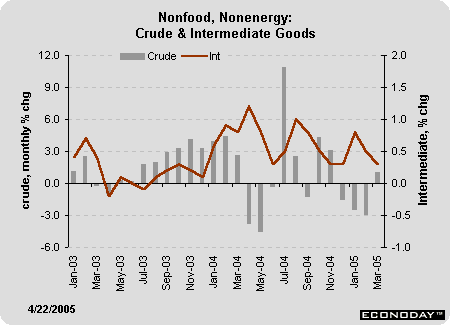
Analysts also look at the core components of the crude and intermediate goods indexes to get a sense of price pressures in the pipeline. After declining for three straight months, the core crude materials index increased 1 percent in March. In contrast, the core intermediate index posted its smallest monthly gain in four months. The core crude materials index is actually posting fewer consistent gains than a year ago, while the intermediate index has risen more in the past 12 months than in the previous 12 months. On the whole, the readings suggest that inflation pressures in the pipeline are not accelerating rapidly, though the core PPI for finished goods might see some larger gains in coming months (above a 0.1 percent monthly average).
March CPI leaps 0.6 percent
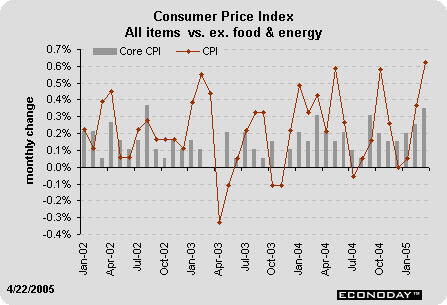
The consumer price index surged 0.6 percent in March after posting a 0.4 percent hike in February. Energy prices surged 4 percent in March, twice as fast as February's 2 percent hike. Food prices remained subdued. Excluding food and energy, the CPI jumped 0.4 percent, accelerating its pace over the past few months. Notice that the index has accelerated each month this year. Most of the components showed higher inflation in March relative to the past few months.
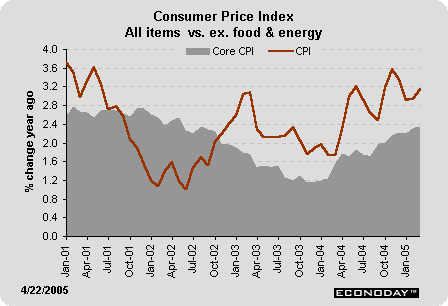
On a year-over-year basis, the CPI rose 3.1 percent while the core CPI was 2.3 percent higher than a year ago. A 2.3 percent inflation rate is not as disturbing as the upward trend. Notice that the rate of inflation is nearly double what it was a little over a year ago. Granted, a core rate near 1 percent was worrisome to policymakers for other reasons (remember deflation'), but now there is no question that inflation is accelerating. Fed officials prefer the PCE deflator to the CPI as a policy guide. While the two are computed in a different way, the PCE deflator does include underlying CPI data. Thus, the upward trend, while less pronounced, will also be evident in the core PCE deflator when it is reported at the end of the month (within the personal income and outlays release on April 29).
Housing starts plunge in March - or do they'
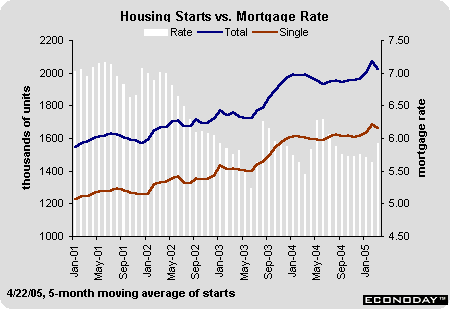
Housing starts plunged 17.6 percent in March to a 1.837 million-unit rate after rising 1.8 percent in February to a 2.229 million-unit rate. Starts were down 8.2 percent from a year ago. Single-family starts fell 14.4 percent to a 1.539 million-unit rate in March while multi-family starts plunged 30.9 percent to a 298,000-unit rate. Given the rise in monthly mortgage rates - the March average was 30 basis points higher than the February average - many economists have expected housing activity to moderate. But the March freefall was more than expected. Some economists cited unusual weather conditions during the month.
But the Census Bureau tells us that it takes five months to establish a trend in housing starts. Using this method to monitor housing activity, we do see that housing starts have dipped recently, but one month is not enough to establish a new downward trend. Most likely the downward movement will continue, but the March drop overstates the weakness for the month and one needs to take a broader view.
Philadelphia Fed Business Outlook Survey jumps
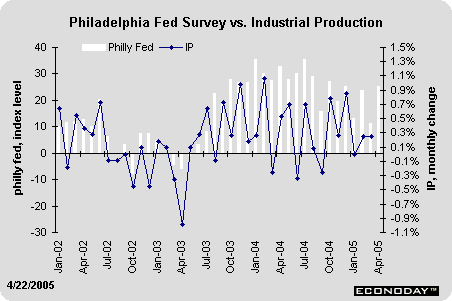
The general business conditions index of the Philadelphia Fed's business outlook survey more than doubled in April to 25.3 from a level of 11.4 in March. This puts it back in line with the February level. Among the various other components of the survey, new orders jumped 7 points to 20.3, shipments doubled to 29.4 and inventories turned from a -5.3 in March to a positive 3.4 in April. Both the prices paid and the prices received indexes surged, but that should come as no surprise to anyone buying gasoline for their car. The average employee workweek index also surged from 2.6 in March to 20.4 in April. On the whole, it appears that manufacturing conditions in this Fed region improved dramatically in April over the March pace.
The Philadelphia Fed Survey has a long history, and it does a generally good job of predicting direction in the nation's index of industrial production. Industrial production growth was highly volatile in 2004, but the trend has been more positive in the past six months. The Philly Fed survey suggests a rise in production in April.
The Bottom Line
Inflation news was not friendly, although the core PPI was at least stable for the month. More worrisome was the upward trend in the core CPI. Fed policymakers are closely monitoring the PCE deflator excluding food and energy prices. While the underlying prices come from the CPI, the index is calculated differently and will likely show a lower inflation rate. Nonetheless, the core PCE deflator is also trending higher. This index will be reported Friday, April 29.
In addition to the personal income and outlays figures, next week will also bring first quarter GDP growth, durable goods orders and consumer confidence, among others.
Looking Ahead: Week of April 25 to April 29
Monday
Existing home sales decreased moderately in February to a 6.79 million-unit rate, falling to their lowest level since last September. Sales of existing homes are counted at closing, while sales of new homes are counted when a contract is signed. New home sales had increased in February and this could point to a rise in existing home sales in March.
Existing home sales Consensus Forecast for Mar 05: 6.75 million-unit rate
Range: 6.50 to 6.85 million-unit rate
Tuesday
The Conference Board's consumer confidence index fell 2 points in March to 102.4. This was the second straight drop after the index reached a near term peak in January. Accelerating inflation without healthy labor market improvement may continue to dampen consumer confidence.
Consumer confidence Consensus Forecast for Apr 05: 98
Range: 95 to 101.6
New single-family home sales rose in February to a 1,226,000-unit rate. Recent increases in mortgage rates could cause procrastinators to start shopping before rates move higher! Nevertheless, the drop in March housing starts could signal a pause in new home sales as well.
New home sales Consensus Forecast for Mar 05: 1,190,000
Range: 1,150,000 to 1,235,000-unit rate
Wednesday
New orders for durable goods rose 0.5 percent in February after falling in January. Several key components (fabricated metals, machinery, electrical equipment) posted declines last month. Improvement in new orders is essential in boosting industrial production growth this year.
Durable goods orders Consensus Forecast for Mar 05: 0.3 percent
Range: -2.0 to +1.5 percent
Thursday
New jobless claims dropped 36,000 in the week ended April 16 to 296,000, the lowest level since the first week of February. Special factors (Easter) boosted claims at the end of March and have also led to a drop in claims over these past three weeks. At this point, it is difficult to determine the true underlying level of claims.
Jobless Claims Consensus Forecast for 4/23/05: 325,000 (29,000)
Range: 310,000 to 350,000
Real GDP expanded at a 3.8 percent rate in the fourth quarter with healthy gains in consumption and investment spending. First quarter spending on consumer goods will most likely be slower. In addition, the nation's widening trade deficit will also take a chunk out of GDP growth.
Real GDP Consensus Forecast for Q1 05: 3.5 percent annual rate
Range: 2.6 to 4.0 percent annual rate



 Inflation is the name of the game

