New Fed Chairman Ben Bernanke managed to answer concisely and with aplomb the politically charged questions put to him by the House Financial Services and Senate Banking Committees. His style is much different from the former chairman's in that he was clear and kept his answers short. Even more to the point, he refused to answer policy questions. On more than one occasion, he respectfully replied that the elected officials were supposed to make policy choices, not him. So, while he agreed that the fiscal deficit was too large, he refused to suggest ways in which to reduce the deficit. And he agreed the current account deficit was also too large, but he favored a slow reduction in this deficit to avoid disruptions to the U.S. economy.
Chairman Bernanke agreed with the assessment coming out of the January 31 FOMC meeting and suggested that the Fed may be raising rates further. He agreed that there were two errors the Fed could make: not raising rates enough, and raising too much. Clearly, there is a fine line that Fed officials have to balance.
In his first outing to Capitol Hill as Federal Reserve chief, Bernanke offered no surprises. He focused on promoting the Fed's dual mandates of price stability and full employment. On the whole, his remarks were not market moving - and that may be good.
Recap of US Markets
STOCKS
The days with the largest equity price increases corresponded to the days with large declines in oil prices. For the most part, no one can claim that new Fed Chairman Ben Bernanke hurt the markets because equity prices rose on Wednesday and Thursday, days that he was testifying on Capitol Hill. Sharp retail sales gains had to help equity prices - even though the retail sales increases, along with the surge in January housing starts, is attributable to unseasonably warm weather.
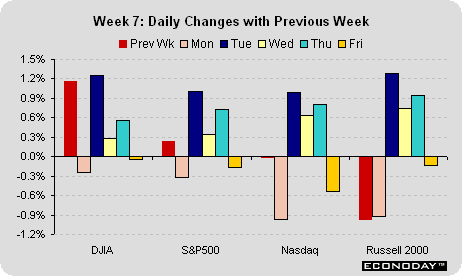
The year began on a good note - and this positive trend in year-to-date gains in the stock market continues. The Dow Jones industrials are up 3.7 percent from year-end; the S&P 500 is 3.1 percent higher; and the Nasdaq composite index is up 3.5 percent. The Russell 2000, measuring the small cap market, continues to outperform the large cap sector, up 8.6 percent from year-end levels.
BONDS
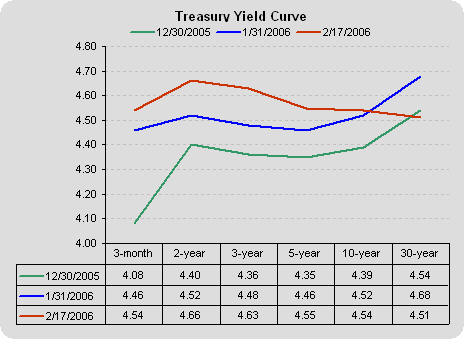
Fed Chairman Ben Bernanke agreed with Greenspan in suggesting that the inverted yield curve is not pointing to an economic slowdown. Bernanke believes the global savings glut is causing yields at the long end of the curve to be low because of high demand for long-term Treasury securities. He also believes, as his predecessor did, that inflationary expectations are well maintained.
The minutes of the January 31 FOMC meeting may be telling, but Bernanke's testimony on Capitol Hill this week, along with the post-meeting statement, suggest that the Fed will indeed raise the fed funds rate target at the March meeting. Everyone agrees that future Fed rate hikes are data dependent. January data will be misleadingly strong, but February figures are likely to show more weakness as weather conditions get more normal for this time of year. For now, the majority of market players are counting on a March rate hike. Anything beyond then is still a question mark.
Markets at a Glance
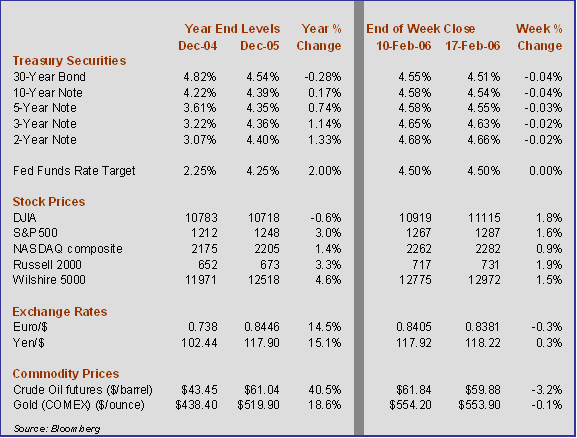
Weekly percent change column reflects percent changes for all components except interest rates. Interest rate changes are reflected in simple differences.
The Economy
NON-ENERGY INFLATION ACCELERATES IN JANUARY
The producer price index increased 0.3 percent in January, half as much as December's 0.6 percent hike. But food prices inched up only 0.2 percent and energy prices were unchanged during the month. In contrast, the PPI excluding food and energy increased 0.4 percent in January, the largest monthly rise in 12 months. Among the core components, drug prices jumped 0.6 percent for the second straight month after a hefty 1.6 percent jump in November. Auto prices rose 1.1 percent in January and light truck prices increased 0.7 percent for the month. This likely reflects the end of heavy-duty incentives. But while car prices were down 2.7 percent versus a year ago, and light truck prices were 4.8 percent lower than a year earlier, drug prices were up 6.5 percent compared with last January. And drug price increases in the PPI are certainly passed along to the consumer price index. Other components showed a more sanguine scenario.
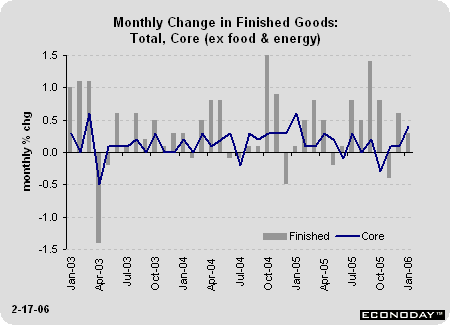
The Fed closely monitors each and every inflation indicator. Many analysts believe that the producer price index and the consumer price index (which will be out on Wednesday) are actually lagging indicators of inflation and that Fed officials should monitor inflation indicators at earlier stages of processing. In fact, they do monitor all stages of inflation. The intermediate goods index rose 1.2 percent while the crude materials index fell 0.5 percent in January. The bulk of the crude goods index includes fuel and food prices, and is less useful in predicting future changes in the finished goods index. Excluding food and energy prices, intermediate goods prices were up 4.8 percent in January over a year ago, and crude goods prices were 6 percent higher than a year ago. This compares with only a 1.5 percent year-over-year gain in the finished goods index. Either this means that finished goods prices will accelerate, or it points to a squeeze in producers' profit margins.
WEATHER BOOSTS HOUSING ACTIVITY
Housing starts jumped 14.5 percent in January to a 2.276 million-unit rate after dropping 6.9 percent in December. Single-family starts increased 12.8 percent during the month while multi-family starts surged a whopping 21.9 percent. Regular readers of Simply Economics know I like to chart housing starts in the form of a 6-month moving average, the time the Census Bureau estimates is needed to establish a trend in starts. But in this case the month-to-month chart below better depicts the inherent volatility in this series. With the average monthly temperature about 8 degrees warmer than the typical January, there is no question that housing starts were boosted by the weather, and not by increased demand for new units. The weekly MBA purchase applications index has come down sharply in January from the higher levels recorded in the final months of 2005.
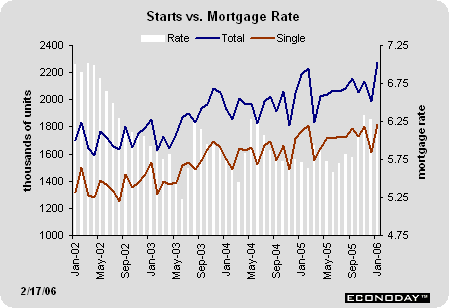
In contrast, February temps are more in line with the average winter. And there is no question that last weekend's blizzard conditions will impact economic data in a negative fashion when February data is reported. Arctic air streams are hitting many regions of the country that normally see more balmy weather conditions.
While the level of January housing starts may be temporary, it is likely that housing activity will remain at generally strong levels in coming months. Right now, neither Wall Street nor Fed economists are predicting a sharp fall off in the housing market, but rather a more gradual downward trend.
RETAIL SALES SPURT
Holiday sales were originally deemed disappointing, but January might have made up for that. Total retail sales surged 2.3 percent in January, and excluding the volatile auto sector, sales were up a hefty 2.2 percent. Of course, gas station sales surged 5.5 percent and this was primarily due to higher pump prices. Excluding auto and gas station sales, retail sales were still up a healthy 1.8 percent. Sales were up across the board in all categories - and all categories posted large gains. Some analysts believe that gift cards played a role. That is certainly possible. However, a warmer-than-normal January simply pushed consumers out the door and into the mall! Indeed, the only weakness in January retail sales came from the "nonstore" component.
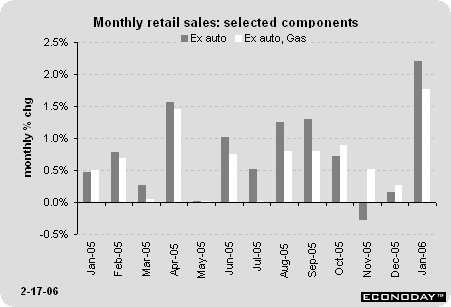
January sales could turn out to be a blip on the chart. Blizzard conditions on the East Coast and cold weather across the country will probably cause February activity to be dampened. And it will be more reasonable to look at average activity over the two months.
Incidentally, the University of Michigan's consumer sentiment index fell several points at the mid-February reading to 87.4 from January's final reading of 91.2. This suggests that consumers are not as optimistic as they were in the past couple of months. The report shows that consumers are less confident about current conditions as well as expectations of the future. In contrast to the Conference Board survey, which is more geared towards labor market conditions, this survey reflects consumers' personal financial conditions. No doubt, consumers are not enjoying the rising prices at the pump. And perhaps they are starting to feel the pinch of higher interest rates. With the fed funds rate at 4.5 percent, this boosts banks' prime rate to 7.5 percent. Home equity loans as well as credit card rates are tied to the prime rate.
DECEPTIVE DROP IN PRODUCTION
The index of industrial production dipped 0.2 percent in January after growing at a steady 1 percent average rate in the three previous months. This was due to warm weather. What' Manufacturing production posted a healthy 0.7 percent gain in January, but utilities production plunged 10.1 percent during the month because warm weather prevented electric and gas utilities from normal activity for the month of January - typically a frigid month. Electric output was down 2.5 percent from a year ago, and gas output was down a whopping 14.7 percent from year ago levels. In contrast, manufacturing production posted a year-over-year gain of 4.5 percent in January.
Production of motor vehicles and parts grew 2.3 percent in January and offset the November drop. This was the first monthly gain in auto output since last September. High tech production also helped boost manufacturing activity, rising 1.5 percent in January. High tech output is up 24.3 percent from year ago levels.
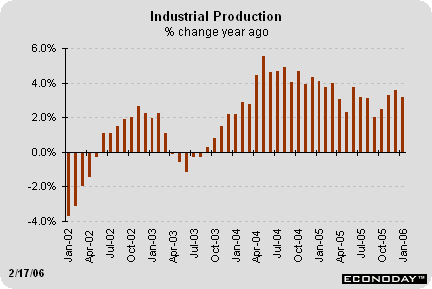
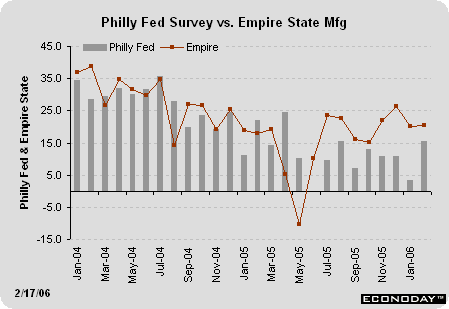
Despite the blizzard on the East Coast, manufacturing activity may still perform well in February. The Philadelphia Fed's business outlook survey showed improvement over the previous month, and the Empire State manufacturing survey showed equally strong activity. Utilities production is also likely to rebound sharply in February, as cold Arctic air seems to be the norm this month after an exceptionally warm January.
The Bottom Line
Ben Bernanke performed well on Capitol Hill in his first outing as the new Fed chairman. In my view, many of the Congressional leaders did not show the same respect to the new chairman that they showed to Alan Greenspan, but Mr. Bernanke was not deterred. His responses were clear and concise, and he refused to answer questions that he did not believe in his purview. Good for him! From a market standpoint, his comments were not unexpected and he did not cause financial markets to gyrate sharply.
January was an exception month - from a weather standpoint. Consequently, housing starts and retail sales surged. Utilities output plunged, although industrial production outside of the utilities arena performed moderately well. February figures could show a reverse path in most of these indicators. It will be useful to look at the average January-February figures to get a sense of where the economy stands.
Although the new Fed chairman delivered the semiannual monetary policy report to Congress last week, market players will likely go gaga over the minutes of the January 31 FOMC meeting on Tuesday. Wednesday's CPI figures and Friday's durable goods report are likely to be key events as well.
Looking Ahead: Week of February 20 to February 24
Tuesday
A few components of the index of leading indicators were negative in January: building permits, consumer expectations and the interest rate spread. Some components had a strong positive influence on this index: new jobless claims and stock prices. The factory workweek was unchanged during the month.
Leading indicators Consensus Forecast for Jan 06: 0.6 percent
Range: 0.2 to 0.8 percent
Wednesday
The consumer price index decreased 0.1 percent in December helped by a 2.1 percent drop in energy prices. Excluding food and energy, the CPI rose 0.1 percent for the month, dampened by a 0.3 percent drop in apparel prices and smaller housing & medical care costs. Energy prices will be up, however, in the January index.
CPI Consensus Forecast for Jan 06: 0.5 percent
Range: 0.3 to 0.6 percent
CPI ex food & energy Consensus Forecast for Jan 06: 0.2 percent
Range: 0.1 to 0.4 percent
Thursday
New jobless claims rose 19,000 in the week ended February 11 to 297,000, bringing the 4-week moving average up to 283,000. This was the second straight weekly gain in jobless claims after several weekly declines. Just like exceptionally warm weather in January boosted overall activity, it is possible that a cold February could dampen activity and claims could rise further. On the whole, claims are still likely to show improvement in January-February over the final quarter of 2005.
Jobless Claims Consensus Forecast for 2/18/06: 300,000
Range: 275,000 to 307,000
Friday
New orders for durable goods jumped sharply over the three past months, boosted primarily by healthy aircraft orders. But every now and then, aircraft orders plunge. Machinery orders have also been healthy in the past few months.
Durable goods orders Consensus Forecast for Jan 06: -1.2 percent
Range: -2 to +0.5 percent




 Weather boosts January activity
