|
Global Economics
will be taking the next week off. Next article will be dated January 2, 2026
Pre-Holiday US Data Release
Crunch Coming Dec. 23
By Theresa Sheehan, Econoday Economist
The data release schedule in the December 22 week is
curtailed by the presence of the Christmas holidays. In the US, Christmas Eve
on Wednesday is not an official holiday, nor is Boxing Day on Friday. Christmas
is a holiday on Thursday. As a result, many people will extend their time off
by taking vacation on Wednesday and Friday. Some will further extend that into
the next week through the New Year observance. There is an early market close
for stocks and bonds on December 24 and a full market close on December 25. On
December 31, there is an early bond market close, but not for stock markets.
January 1 is a full market close for both stocks and bonds. Tuesday morning
sees a rush to get a number of reports out before the holiday period. Most of
these have little market moving potential as they are part of the catch up in
data reporting after the government shutdown.
Among the crush of Tuesday morning releases is the GDP
estimate for the July-September quarter. The BEA is calling it an "initial"
estimate since it combines the normal "advance" and "second estimates". Given
it covers the third quarter 2025, the data in the report is relatively old with
the fourth quarter already approaching its end. Nonetheless, this will be the
first official measure of growth in the third quarter and will help frame
economic activity going into the fourth quarter. The government shutdown
occurred mostly in October and is expected to cut perhaps two-tenths from
growth in the October-December period, according to Fed Chair Jerome Powell. He
anticipated that will be recovered in the first quarter 2026.
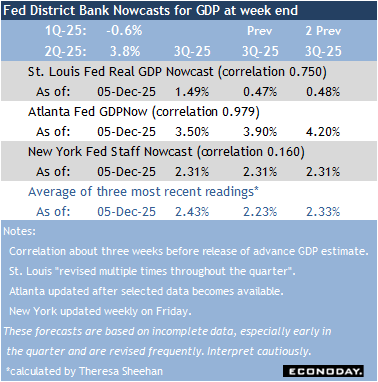
The GDP Nowcasts from three Fed district banks point to
growth centering around 2.5 percent. The Atlanta Fed GDPNow - the most reliable
of the three - forecasts growth of around 3.5 percent. It seems probable that
consumer spending continues to buoy expansion despite the impacts of tariffs or
because of them as consumers front-load purchases in anticipation of higher
prices. Whether this momentum carries into the fourth quarter remains to be
seen.
Singapore, Taiwan Industrial
Production Reports in Focus
By Brian Jackson, Econoday Economist
The Asia-Pacific data calendar is very light. Singapore will
report industrial production and inflation data, Hong Kong will report
inflation data, and Taiwan will report industrial production data.
United Kingdom GDP for Third Quarter (Mon 0700 GMT; Mon
0200 EST)
Consensus Forecast, Q/Q: 0.1%
Consensus Range, Q/Q: 0.1% to 0.1%
Consensus Forecast, Y/Y: 1.3%
Consensus Range, Y/Y: 1.3% to 1.3%
In the final revision for Q3 GDP, forecasters see no
revision from the previously reported 0.1 percent Q/Q and 1.3 percent Y/Y.
Singapore CPI for November (Tue 1300 CST; Tue 0500
GMT; Tue 0000 EST)
Consensus Forecast, Y/Y: 1.2%
Consensus Range, Y/Y: 1.1% to 1.4%
The consensus sees CPI up 1.3 percent on year in November compared
with 1.2 percent in October.
Canada Monthly GDP for October (Tue 0830 EST; Tue
1330 GMT)
Consensus Forecast, M/M: -0.3%
Consensus Range, M/M: -0.4% to 0.0%
The consensus agrees with the Stats Canada estimate calling
for a decrease of 0.3 percent in October after an increase of 0.2 percent in
September.
US Durable Goods Orders for October (Tue 0830 EST; Tue
1330 GMT)
Consensus Forecast, New Order - M/M: -1.5%
Consensus Range, New Order - M/M: -4.5% to 0.6%
Consensus Forecast, Ex-Transportation - M/M: 0.1%
Consensus Range, Ex-Transportation - M/M: -1.0% to
0.4%
Another month of plunging aircraft orders expected to
depress the headline number but leave ex-transportation nearly flat at plus 0.1
percent.
US GDP for Third Quarter (Wed 0830 EST; Wed 1330 GMT)
Consensus Forecast, Q/Q - Annual Rate: 3.2%
Consensus Range, Q/Q - Annual Rate: 2.5% to 3.8%
Consensus Forecast, Personal Consumption Expenditures -
Annual Rate: 2.7%
Consensus Range, Personal Consumption Expenditures -
Annual Rate: 2.7% to 3.1%
Growth expected at a robust 3.2 percent in Q3 with a lift
from net exports. PCE seen at a decent 2.7 percent.
US Industrial Production for November (Tue 0915 EST;
Tue 1415 GMT)
Consensus Forecast, Industrial Production - M/M: 0.1%
Consensus Range, Industrial Production - M/M: -0.4%
to 0.3%
Consensus Forecast, Capacity Utilization Rate: 75.9%
Consensus Range, Capacity Utilization Rate: 75.7% to 76.1%
Output expected barely changed and capacity utilization flat
too in line with anemic ISM purchasing managers manufacturing indexes.
US Consumer Confidence for December (Tue 1000 EST; Tue
1500 GMT)
Consensus Forecast, Index: 91.9
Consensus Range, Index: 89.0 to 94.5
Confidence indicator expected better but still depressed at
91.9 for December after falling 6.8 points to 88.7 in November from 95.5 in
October. Consumers remain worried by pocketbook issues.
US Jobless Claims Week 12/20 (Wed 0830 GMT; Wed 1330
EST)
Consensus Forecast, Initial Claims - Level: 225K
Consensus Range, Initial Claims - Level: 217K to 235K
Claims expected at 225K, not much changed from 224K last
week, which is down 13 from the week before that. It's a noisy indicator week
to week but the trend has been remarkably stable given all the sturm and drang
over the job market.
Japan Tokyo CPI for December (Thu 0830 JST; Wed 2330
GMT; Wed 1830 EST)
Consensus Forecast, CPI - Y/Y: 2.4%
Consensus Range, CPI - Y/Y: 2.1% to 2.5%
Consensus Forecast, Ex-Fresh Food - Y/Y: 2.5%
Consensus Range, Ex-Fresh Food - Y/Y: 2.5% to 2.7%
Consensus Forecast, Ex-Fresh Food & Energy - Y/Y:
2.9%
Consensus Range, Ex-Fresh Food & Energy - Y/Y: 2.7%
to 2.9%
The Tokyo consumer price index, a leading indicator of
nationwide inflation trends, is expected to decline on the year for the first
time in four months in December, reflecting lower prices at supermarkets
through the earlier part of the month.
The core measure (excluding fresh food) is forecast to post
a rise of 2.5 percent on the year in December, slowing from 2.8 percent in
November. The total CPI is seen gaining 2.4%, down from a 2.7 percent rise in
the previous month, while the core-core index (excluding fresh food and energy)
is expected to edge up to 2.9 percent from 2.8 percent in November. All three
readings have remained below 3 percent since June after easing from earlier
peaks.
Japan Unemployment Rate for November (Thu 0830 JST; Wed
2330 GMT; Wed 1830 EST)
Consensus Forecast, Rate: 2.6%
Consensus Range, Rate: 2.5% to 2.6%
Broad-based labor shortages are expected to push Japanese
payrolls higher for a 40th consecutive year-on-year increase in November, while
the seasonally adjusted unemployment rate is seen edging lower. This aligns
with the Bank of Japan's Tankan corporate sentiment survey for the December
quarter, which pointed to strong labor tightness across sectors, with shortages
particularly acute among smaller firms.
The seasonally adjusted unemployment rate is expected to be
stable at 2.6 percent in November from a month earlier. In October, employment
rose by 520,000 on the year to 68.65 million, led by gains in the medical and
welfare industries, while declines were recorded in farming, manufacturing, and
the wholesale and retail sectors.
The number of unemployed increased by 130,000, bringing the
total to 1.83 million in October. By reason for job seeking compared with a
year earlier, layoffs due to employer circumstances increased by 40,000,
voluntary departures rose by 50,000, and new job seekers increased by 40,000
during the month.
Japan Industrial Production for November (Thu 0850
JST; Wed 2350 GMT; Wed 1850 EST)
Consensus Forecast, M/M: -1.3%
Consensus Range, M/M: -2.5% to 0.5%
Consensus Forecast, Y/Y: -1.0%
Consensus Range, Y/Y: -2.0% to 1.0%
Japan's industrial output is expected to return to a
downward path in November, falling 1.3 percent from the previous month after
rising unexpectedly in October, driven by a recovery in auto production as well
as gains in industries such as electrical machinery and information and
communications equipment.
Output in November is seen falling as cuts are anticipated
in sectors including transport equipment, information and communications
machinery, and chemicals. Persisting U.S. tariff policies are also seen
weighing on production in the auto and metals sectors. The Ministry of Economy,
Trade and Industry has projected that output will slip 2.6 percent in November
before declining a further 2.0 percent in December. The ministry maintained its
long-held assessment that industrial output is "taking one step forward and one
step back."
On the year, November output is expected to dip 1.0 percent
after rising 1.6 percent (revised from up 1.5 percent) in the prior month.
Japan Retail Sales for November (Thu 0850 JST; Wed
2350 GMT; Wed 1850 EST)
Consensus Forecast, M/M: 0.5%
Consensus Range, M/M: 0.2% to 0.5%
Consensus Forecast, Y/Y: 0.7%
Consensus Range, Y/Y: -0.5% to 0.9%
Japanese retail sales are seen rising 0.7 percent on the
year in November, marking a third consecutive month of gains after increasing
1.7 percent the previous month, supported by firm demand for drugs and
cosmetics and a rebound in auto sales.
The uptrend in retail sales is expected to continue, though
but growth is expected to be slower as signs of weaker sales at major
department stores, softer motor vehicle sales, and a drop in new passenger car
registrations weigh on overall performance.
On the month, retail sales are projected to rise 0.5 percent
rise on a seasonally adjusted basis, following a 1.6 percent gain in October
and flat growth in September.
|


![[Econoday]](images/econoday_logo_slim.gif)
![[Econoday]](images/logo.gif)