|
Just before every FOMC meeting, there is plenty of commentary about the current stance of monetary policy and what the Fed might or should do. But sometimes we forget that the dollars in the financial markets are telling us what traders and investors really think. We can check selected financial or price data and get an objective view of what the markets are thinking. For our edification, we can check the fed funds futures market, compare changes in yield curves, see how the TED spread is behaving, look at whether the Fed has helped with mortgage rates, and check to see if banks are in the market for lending. Yes, the markets have been telling about Fed policy—we just need to take time to listen.
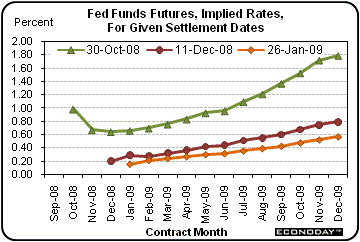 Probably the market that focuses the most on Fed policy is the fed funds futures market. Here, traders are making bets on what the fed funds rate is going to be in coming months. At the December 15-16 FOMC meeting, the Fed slashed its target rate down to a range of zero to 0.25 percent—bringing the target in line with an effect fed funds rate that for weeks had been trading at about 0.10 percent. In the meeting statement and in later released minutes, the Fed said it was going to keep the policy rate at then current levels “for some time.” Since the meeting, Fed officials have indicated that the economy worsened in the fourth quarter and will likely contract significantly in the first. So, what does the fed fund futures market think about near-term fed policy—does the market believe the Fed’s word' Probably the market that focuses the most on Fed policy is the fed funds futures market. Here, traders are making bets on what the fed funds rate is going to be in coming months. At the December 15-16 FOMC meeting, the Fed slashed its target rate down to a range of zero to 0.25 percent—bringing the target in line with an effect fed funds rate that for weeks had been trading at about 0.10 percent. In the meeting statement and in later released minutes, the Fed said it was going to keep the policy rate at then current levels “for some time.” Since the meeting, Fed officials have indicated that the economy worsened in the fourth quarter and will likely contract significantly in the first. So, what does the fed fund futures market think about near-term fed policy—does the market believe the Fed’s word'
Checking out the implied fed funds rates, the futures market sees the policy rate staying below 0.25 percent through mid-year and no higher than 0.5 percent by year end. So, fed funds futures traders believe the Fed is going to keep rates low, also implying that the economy is going to be weak all year.
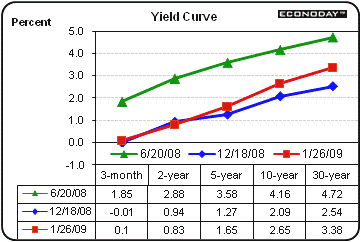 Over the past year, the Treasury yield curve has moved dramatically—and there is much to learn from the changes. At mid-2008, financial markets had improved temporarily and oil prices were still spiraling upward. The Fed had not yet slashed the target rate to near zero and inflation was a rising concern. By mid-December, the Fed had cut the target rate to essentially zero and the economy was seen as deep in recession. Treasury yields were low across the curve. But recently, longer rates have been firming noticeably. Either there is less flight to safety, inflation worries are boosting yields, or concerns over massive Treasury borrowing in the pipeline have bumped rates up—or all of the above. But the rise in longer rates at a minimum reflects a higher premium in part due to higher inflation expectations. The Fed’s quantitative easing does not leave the bond markets feeling easy about inflation. Over the past year, the Treasury yield curve has moved dramatically—and there is much to learn from the changes. At mid-2008, financial markets had improved temporarily and oil prices were still spiraling upward. The Fed had not yet slashed the target rate to near zero and inflation was a rising concern. By mid-December, the Fed had cut the target rate to essentially zero and the economy was seen as deep in recession. Treasury yields were low across the curve. But recently, longer rates have been firming noticeably. Either there is less flight to safety, inflation worries are boosting yields, or concerns over massive Treasury borrowing in the pipeline have bumped rates up—or all of the above. But the rise in longer rates at a minimum reflects a higher premium in part due to higher inflation expectations. The Fed’s quantitative easing does not leave the bond markets feeling easy about inflation.
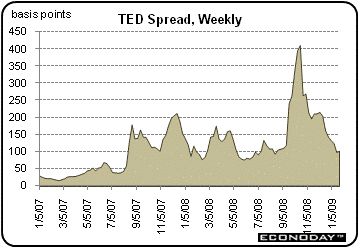 Over the past year, the Fed has had to deal with off and on seizing of the credit markets. Repeatedly, the Fed injected massive amounts of liquidity into the financial system when credit markets froze. One of the indicators the Fed watched and still watches is the TED spread. TED is short for Treasury-Eurodollar. So, the TED spread began as the difference between the yield on the Eurodollar minus the yield on the equivalent Treasury bill—the 3-month for both. Today, the TED spread is the difference between the 3-month dollar-denominated LIBOR rate and the 3-month T-bill. The TED spread is seen as an indicator of credit risk in the economy. When lenders believe the risk of default is rising, they boost the LIBOR rate. A rise in the LIBOR rate also reflects tighter or less available credit. Over the past year, the Fed has had to deal with off and on seizing of the credit markets. Repeatedly, the Fed injected massive amounts of liquidity into the financial system when credit markets froze. One of the indicators the Fed watched and still watches is the TED spread. TED is short for Treasury-Eurodollar. So, the TED spread began as the difference between the yield on the Eurodollar minus the yield on the equivalent Treasury bill—the 3-month for both. Today, the TED spread is the difference between the 3-month dollar-denominated LIBOR rate and the 3-month T-bill. The TED spread is seen as an indicator of credit risk in the economy. When lenders believe the risk of default is rising, they boost the LIBOR rate. A rise in the LIBOR rate also reflects tighter or less available credit.
Over the long-term, the TED spread typically has ranged from 30 to 50 basis points. But late in 2008, the TED spread hit an historical high of 465 basis points on October 10. The surge was due to a collapse in equity markets and lenders fearing the worst from recession.
So, how are credit markets doing now according to perceived risks' Have Fed actions improved willingness to lend, based on the TED spread' The TED spread is now running about 100 basis points. This is substantially above its long-term average level but sharply lower than the latter part of 2008. The Fed’s quantitative easing has had a significant impact on credit markets.
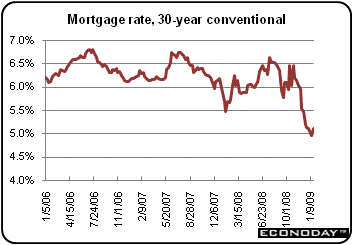 For more than a year, economists have been stating that the economy is not going to turn around until housing picks up. Well, one important facet of that issue is whether housing is more affordable. The Fed in recent weeks announced that mortgage markets need special attention to boost credit availability and increase lending. The Fed has given Fannie Mae and Freddie Mac access to its credit. Has there been an impact on mortgage markets' For more than a year, economists have been stating that the economy is not going to turn around until housing picks up. Well, one important facet of that issue is whether housing is more affordable. The Fed in recent weeks announced that mortgage markets need special attention to boost credit availability and increase lending. The Fed has given Fannie Mae and Freddie Mac access to its credit. Has there been an impact on mortgage markets'
Based on mortgage rates, the answer is a resounding yes. Just within the last six months, conventional mortgage rates have come down from the 6.5 percent vicinity to just above 5 percent. This can be a major boost to housing once labor markets stabilize.
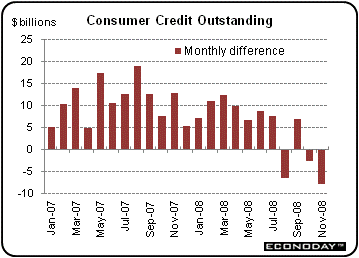 Have credit markets been lending to consumers' Have Fed policies trickled down to the consumer' Unfortunately, the answer is no. Consumer credit posted a record decline of $7.9 billion for November -- the third decline in four months. Revolving credit fell $2.8 billion, or 3.4 percent in the month, while nonrevolving credit fell $5.2 billion, or 3.9 percent. It is extremely unusual for outstanding credit to outright decline – as opposed to gains merely slowing. Even on a year-ago basis, credit growth has hit the brakes. The year-ago pace is down from a recent high of 5.8 percent for October 2007 to 2.3 percent for the latest month. The recent downward trend likely reflects both credit card companies and other lenders tightening credit standards and also consumers pulling back on spending due to recession concerns. The Fed is establishing special credit facilities to address consumer credit difficulties. This could be one of the big issues at this week’s FOMC meeting. Have credit markets been lending to consumers' Have Fed policies trickled down to the consumer' Unfortunately, the answer is no. Consumer credit posted a record decline of $7.9 billion for November -- the third decline in four months. Revolving credit fell $2.8 billion, or 3.4 percent in the month, while nonrevolving credit fell $5.2 billion, or 3.9 percent. It is extremely unusual for outstanding credit to outright decline – as opposed to gains merely slowing. Even on a year-ago basis, credit growth has hit the brakes. The year-ago pace is down from a recent high of 5.8 percent for October 2007 to 2.3 percent for the latest month. The recent downward trend likely reflects both credit card companies and other lenders tightening credit standards and also consumers pulling back on spending due to recession concerns. The Fed is establishing special credit facilities to address consumer credit difficulties. This could be one of the big issues at this week’s FOMC meeting.
The bottom line is that the Fed has made progress in stabilizing the credit markets. The big problem for now, however, is that banks have grown more cautious about lending—they noticed that we are in recession and consumer and business default risk is up. The problem not too far in the future is that inflation potential has risen and the Fed indeed will have to withdraw liquidity quickly once recovery appears to have been put in motion. Meanwhile, the Fed will need to target its credit easing—and the consumer credit markets appear to be in critical need.
|

![[Econoday]](images/econoday_logo_slim.gif)
![[Econoday]](images/logo.gif)
