|
The euro is 10 years old and has succeeded beyond expectations. The eurozone or European Monetary Union now has 16 members, up from the original 11 and with a number of countries in a queue waiting to join when they qualify. Its success has defied expectations of the late Milton Friedman who said it would never be “an optimal currency area”. But challenges do lie ahead as it confronts the financial crisis and recession.
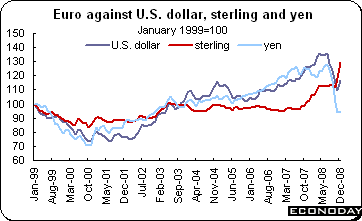 The euro initially was launched as an electronic currency in January 1999. It became a fiat currency on January 1, 2002 when eurozone citizens exchanged their francs, deutschemarks, lira and other currencies for euro notes. Although the euro is considered an attractive shelter during times of economic turmoil, some countries have rejected it. Of the original 15 who formed the European Communities (EC), Britain, Denmark and Sweden chose not to trade in their national currencies for the euro. In 2006, the total value of euro notes in circulation overtook that of the U.S. dollar. The respect the euro has earned as a store of value is also shown in the increase of official reserves held in euros — 27 percent of the 2008 world total, up from 18 percent a decade ago. Over the same period, the dollar’s share fell to 63 percent from 71 percent. The euro initially was launched as an electronic currency in January 1999. It became a fiat currency on January 1, 2002 when eurozone citizens exchanged their francs, deutschemarks, lira and other currencies for euro notes. Although the euro is considered an attractive shelter during times of economic turmoil, some countries have rejected it. Of the original 15 who formed the European Communities (EC), Britain, Denmark and Sweden chose not to trade in their national currencies for the euro. In 2006, the total value of euro notes in circulation overtook that of the U.S. dollar. The respect the euro has earned as a store of value is also shown in the increase of official reserves held in euros — 27 percent of the 2008 world total, up from 18 percent a decade ago. Over the same period, the dollar’s share fell to 63 percent from 71 percent.
The historical roots of the European Union — and the eurozone — lie in the rubble of World War II, when it became imperative to build international relationships to guard against any such catastrophe recurring. It was developed as a political union and essentially remains that even though the impact is economic. The 1951 Treaty of Paris established the European Coal and Steel Community (ECSC), which was joined by France, Germany, Italy, the Netherlands, Belgium, and Luxembourg. This led to the 1958 Treaty of Rome when these six countries founded the European Economic Community and European Atomic Energy Community to work alongside the ECSC. In 1967 the three communities merged to become collectively known as the European Communities whose main focus was to cooperate on economic and agricultural affairs. Denmark, Ireland and Britain became full EC members in 1973 with Greece joining in 1981, Portugal and Spain in 1986 and Austria, Finland and Sweden in 1995.
The 1991 Treaty on European Union which was signed at Maastricht, the Netherlands established the EU as the successor to the European Community. Maastricht expanded the concept of union into new areas. EU citizenship for example, which allowed people to move freely between Member States, was created. But crucially, it established the timetable for economic and monetary union and specified the economic and budgetary criteria that would determine when countries were ready to join. There are now 27 EU members, 16 of which form the European Monetary Union (EMU). The euro's adoption is meant to complete the European single market, facilitating cross-border mergers and price transparency while eliminating exchange-rate risk. Rather, it spreads risk among the countries that use it while doing little to synchronize the eurozone’s economies.
The eurozone is faced with its first recession since its founding — the last European recession was in the mid-1990s. But it was the foreign exchange turmoil during the early 1990s that almost broke up the previous “fixed but adaptable” exchange rate mechanism that had been in place. The choice was either a return to floating currencies or to move on with monetary union.
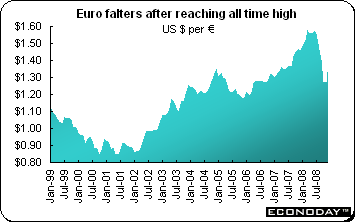 The euro declined against the dollar after its introduction in 1999 but then recovered in mid-2001. It continued to climb in value over the next few years to the pain of European exporters. A rising currency makes goods less competitive. It reached its peak in Mid-July 2008 and then began to weaken once again as the financial crisis escalated and investors shunned risk and fled to the safe haven of the dollar. The euro declined against the dollar after its introduction in 1999 but then recovered in mid-2001. It continued to climb in value over the next few years to the pain of European exporters. A rising currency makes goods less competitive. It reached its peak in Mid-July 2008 and then began to weaken once again as the financial crisis escalated and investors shunned risk and fled to the safe haven of the dollar.
Since then especially, the European Central Bank (ECB) has complained about a poor flow of information from member states as the Bank tried to gain control during the crisis. Organizational issues have kept the EMU from functioning efficiently during the crisis. While there is one central bank — the ECB — there are 16 national regulators and monetary authorities not to mention 16 governments with their own political agendas. And there are 16 government bond markets unlike in the U.S. where there is just one.
Eurozone member states trying to pull themselves out of recession no longer have the option of currency devaluation, which could make the process more painful for some. Capital markets are worried about public finances in some countries which have led to a widening of yield spreads — for example, between Greek and Italian bonds and German debt. These problems could accelerate the reform process and make the eurozone stronger. According to analysts the biggest moves toward economic integration have come with a crisis. Now, the perils of being an outsider have been amplified by the crisis and are encouraging some of the larger EU countries that are outside the EMU to reappraise the shelter offered by membership.
Thus far, the euro has provided a safe haven from fickle foreign capital but has failed to encourage reform. The EMU has been fortunate that there has been a period of economic stability, low inflation and therefore low interest rates. But now investors who once underpriced risk are charging heavily to bear it. This affects companies and governments both inside and outside the euro. As budgetary laxity and weak growth become costlier, reforms are more likely.
Many EMU countries including Greece, Ireland, Italy, Portugal and Spain are suffering badly in the downturn. Housing bubbles have burst in Ireland and Spain and as a consequence, crushed domestic demand. Tax receipts that had been swollen by booms in consumer spending and housing have shriveled. With unemployment rising, public finances are worsening. Greece, like Portugal and Spain, has a big current-account deficit. Italy has a smaller trade gap but, like Greece, has huge public debt. As the prospects for economic growth fade, investors are starting to demand far higher interest rates for holding their sovereign debt than for the safest German government bonds. Indeed the troubled countries have been receiving increased scrutiny from rating agencies such as S&P.
The more challenging economic environment could raise hopes that the euro will be a catalyst for reform. But so far the record is disappointing. Over the past 10 year, productivity growth has been anemic, slowing from 1.6 percent a year prior to the euro’s launch to 0.8 percent since. But healthy employment growth may have depressed productivity because each new worker is less productive than the average. Sluggish productivity also reflects a waning appetite for reform. A European Commission report on the euro’s first decade concluded that members became less ambitious after 1999 — perhaps reflecting ‘reform fatigue’ following the dramatic efforts made to qualify for the first wave of euro entry.
The U.S. dollar remains the reserve currency of choice despite recent financial chaos. The dollar accounts for around two-thirds of global currency reserves, compared with a quarter for the euro. Outside the EU, most cross-border sales are invoiced and settled in dollars. And a third of eurozone trade is dollar-based.
The euro may yet make further ground as a reserve currency — but at the expense of the smaller European currencies, the pound sterling and the Swiss franc. The more important legacy for the euro may be within the currency zone itself. Its status as a haven in the financial storm has dampened voices that are always blaming the euro and the ECB for all economic ills. If that mood is sustained, politicians may look closer to home for solutions to the problems facing their economies. However, the newly discriminating capital markets may nudge them in the right direction.
From the standpoint of economic stability, the euro has been a success so far. If there is cause for disappointment it is that sound money and along with it, price transparency have not fostered faster economic growth. The hope when the euro was launched was that countries stripped of the license to cheapen their currencies would be forced to compete directly, and that competition would lead to more flexible markets and higher productivity. But there has been little improvement in the eurozone’s underlying growth rate while income per person has remained at around 70 percent of that in the U.S.
But for some, the euro cannot realistically challenge the dollar as long as it remains a currency without a state. The euro area with its 16 separate government bond markets cannot rival the liquidity offered by the market for U.S. Treasuries, which have a single issuer. Bonds held as currency reserves are useful if they can be converted to cash quickly and cheaply. The market for German government bonds meets the requirement for liquidity but others fall short.
|

![[Econoday]](images/econoday_logo_slim.gif)
![[Econoday]](images/logo.gif)
