|
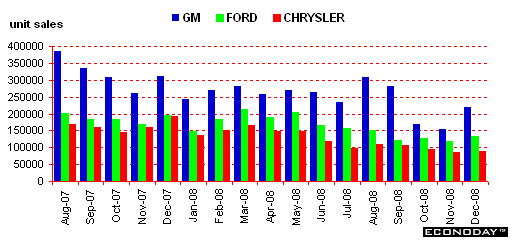
There's no bigger business story in 2009 than the survival of U.S. brand autos. The U.S. government has stepped in, supplying more than $20 billion in direct aid to GM and Chrysler amid reports that the incoming administration will also stand by the Big Three. But there is a major risk that an extended contraction in auto demand will lead to greater government help or perhaps a merger among the Big 3 if not an outright bankruptcy. The graph below tracks the severe contraction in Big 3 unit sales, down an enormous total of 41 percent since August 2007.
Japanese brands are suffering the same troubles with their sales of North American made light vehicles down 42 percent over the same span to indicate — and they are not taking market share away from the Big 3. The graph below tracks unit sales of Toyota, Honda and Nissan. The left axis is the same as the axis for the Big 3, a visual reminder that sales of transplant brands are still comparatively small.
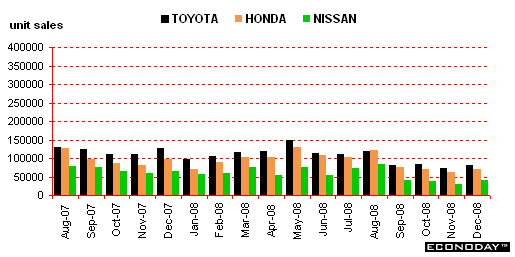
The collapse in demand, and not just here but globally, is taking a record toll on Japanese car makers. Toyota warned last month that it will report its first operating loss in 68 years. The company said just this week that it's suspending production for 11 days at all 12 of its Japanese plants.
But losses for domestic brands are more extreme and raise into question the extent the government may have to go for a successful bailout. Losses at Chrysler totaled $5 billion through the first three quarters of 2008 with losses at Ford totaling nearly $9 billion and losses at GM at more than $19 billion. Fourth quarter results haven't been posted yet but estimates look for losses of the same or even increasing in magnitude.
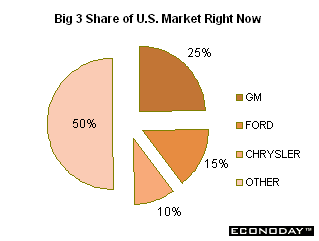
Of the Big 3, Chrysler may be the weakest. The graph below shows the Big 3's U.S. market share. Chrysler, currently at 10 percent, has seen its share erode nearly 5 percentage points since early 2007, losses that have fed small gains in market share for GM and Ford.
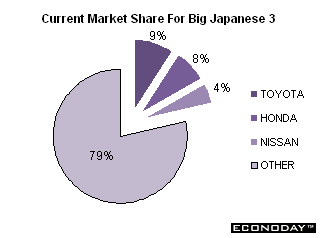
In the graph above, the Big 3 on the Japanese side show similar results. Nissan, the smallest, has given up a couple of percentage points of market share to Toyota and Honda.
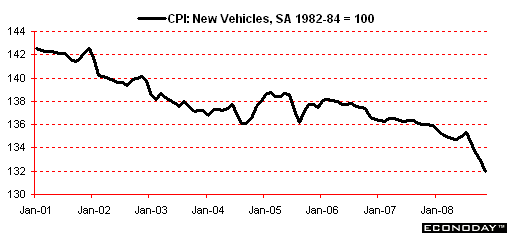
GM's sales in December bounced back on aggressive incentives, a factor that definitely gives a lift to unit sales but at the expense of course of the bottom line. The graph below tracks new vehicle prices in the consumer price report. Prices are on a long decline reflecting product improvements that are translated by government researchers into lower prices. Improvements aside, prices fell very steeply in late 2001 as auto makers issued heavy post 9/11 incentives including the appearance of zero financing. Prices through the second half of 2008 also show a steep decline, again one that currently is a very negative factor for the health of auto makers.
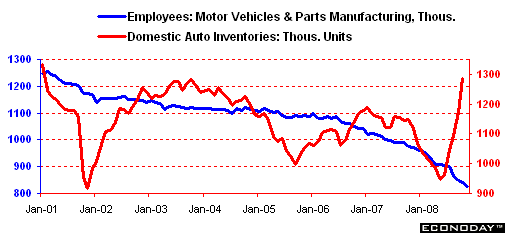
Inventory overhang is also a major problem right now in the auto sector, as it is a growing problem for the whole economy. The jump underway in inventories is certain to depress future production and with it future employment. The graph below tracks auto inventories against domestic employment in vehicle manufacturing.
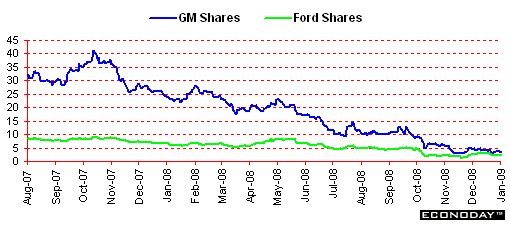
The downturn in the auto sector has had rippling effects through much of the workforce, a factor that is likely to be felt once again in Friday's employment report for December. The downturn has also been depressing retail sales where the motor vehicle component is making up an ever-declining proportion of total sales, now at 16 percent. Vehicle sales in total are down 23 percent through the first 11 months of 2008. No matter how much companies may streamline, cutback or borrow from the government, there is simply too many vehicles chasing too few buyers. An improvement in underlying demand, as it would be for the housing sector, is by far the best cure for the auto industry. Of all the indicators, nothing more clearly shows what's at stake than the share prices of GM and Ford. As shown in the graph below, GM's shares have suffered a startling collapse with now both GM and Ford fighting to stay above the $1 penny stock barrier.
|

![[Econoday]](images/econoday_logo_slim.gif)
![[Econoday]](images/logo.gif)
