|
Many may have casually heard of the Libor but have not paid close attention to what it is. The Libor is a set of interest rates that are set in London but now is having a very significant impact on the U.S. economy that the Fed likely cannot fully offset. For now, the Libor indicates in part that the problem of resetting ARM home loans cannot be solved just by interest rate cuts by the Fed. The positive news is that the Libor suggests that credit markets have improved since the Fed and other central banks began injecting large amounts of funds into the credit markets through special auctions. But there is still plenty of room for credit markets to settle down some more.
The Libor is the London Interbank Offered Rate. It is the rate of interest that banks charge each other in the London interbank market. While individual banks have their own Libor rate, the cited rate is an average that is calculated by the British Bankers’ Association (BBA) and that is the Libor cited here. The Libor is traded in a range of maturities from overnight to one year and in 10 different currencies – with key currencies being the sterling, the dollar, and the euro.
In recent months, financial markets have followed the Libor as it has been a key thermometer of credit markets since the blowup of subprime lending problems in early August 2007. Additionally, policy makers have only recently remembered that many adjustable mortgage rates in the U.S. are tied to Libor. When ARMs are reset in coming months, it is to a Libor index that many will be adjusted and the Libor is not behaving the same as some other short-term rates in the U.S.
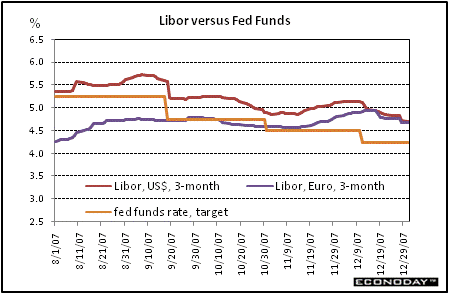
In early August of last year, the Libor – in both dollars and euros – spiked upward after the August 9 sell off in equity markets as unexpectedly large subprime losses were made public in Europe and in the United States. The spread between the Libor and the fed funds target rate jumped sharply on August 10 and continues into early 2008.
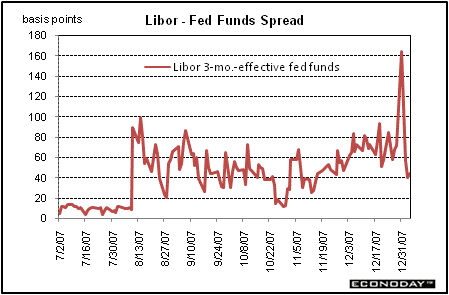
The spread between the Libor and effective fed funds jumped from a 10 basis points vicinity prior to August 10 to roughly 75 to 90 basis points on August 10 and the few days afterward. The spread did ease after central banks announced special injections of liquidity to help un-seize credits markets as the spread dipped back to roughly 50 basis points a week later.
The on-going Term Auction Facility (TAF) run by the Fed to add more funds into the credit markets at face value does not appear to be helping ease the credit markets over the December period but the run up in the spread over the last month is due in part to seasonal demand for cash at year end. This was most evident with a spike on December 31 which fell back sharply after the turn of the New Year. Indeed, during the first week of 2008, this spread was down significantly from highs seen on and after August 10. Taking into account seasonal cash demand, the TAF has helped but we are not yet back to pre-August calm.
The Libor is a benchmark for a number of financial products around the world. A number of financial derivatives are based on some version of the Libor. In the U.S., many adjustable mortgage rates are tied to the Libor. Some of the most popular interest rate indexes used as the base rate for adjustable rate mortgages are the 1-year Treasury bill, the Eleventh District (Federal Home Loan Bank) Cost of Funds Index (COFI), and the Libor – generally the 3-month or 6-month maturity in U.S. dollars. The Cost of Funds Index is primarily affected by the cost to savings & loans for paying interest on savings accounts for savings & loan associations headquartered in Arizona, California, and Nevada. The COFI is a monthly series that is announced with a one month lag. The November number was just announced a few days ago.
What do the trends in these interest rates portend for mortgage rates, notably ARMs' First, one should remember that the Libor, 1-year T-bill, and COFI are just the base portion of an ARM. The actual ARM rate is the base rate plus a mark-up percentage spread rate. Shown below is an ARM interest rate series that is a composite of all of the types using the various underlying interest rates.
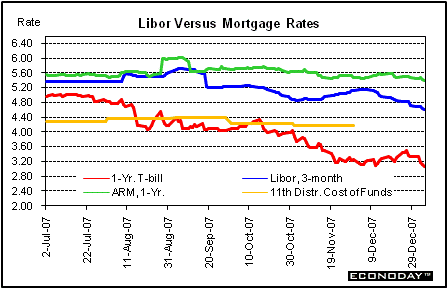
Since early August, there has been varying degrees of declines in these interest rates underlying adjustable rate mortgages. From August through November, the COFI index has hardly budged, slipping just 19 basis points. Interest rates on savings deposits change very slowly and this is a key reason that this index has declined very little.
The 1-year T-bill has fallen the most of these three indexes, from 4.82 percent at the first of August to 3.06 percent at the end of the year – a 176 basis point drop. Fed interest rate cuts have helped along with flight to quality. But what has also helped is the expectation that the Fed is going to continue to cut short-term interest rates over the next year – the maturity horizon of the 1-year T-bill.
The Libor has declined somewhat in between these two, falling from 5.36 percent on August 1 to 4.62 percent on December 31 for a 74 basis point decline. However, the fed funds target rate has been cut 100 basis points over the same period. Essentially, concerns over the value of bank assets has kept the Libor (dollar based) from declining as much as fed funds.
A key concern of many economists is that when ARMs are reset for many subprime borrowers, the rate increase will result in mortgage payments that the borrower won't be able to afford. Which interest rate the ARM is tied to will make a big difference in the new payment amount. Those with a loan based on the 1-year T-bill will likely fare the best while those with the Libor may do the worst – with the caveat that the size of the mark-up spread also affects how much a borrower’s mortgage payment will go up.
But at least three things stand out regarding ARMs and Fed rate cuts. First, while the Fed has cut the fed funds target by 100 basis points since September, not all ARMs have come down that much due to credit market concerns. Further rate cuts are likely to have less than a one-to-one impact on ARMs rates. Finally, the big impact has been on 1-year T-bill rates and that has depended largely on the expectation of future rate cuts by the Fed. If inflation worries cause the Fed to end the easing cycle sooner than expected, then 1-year T-bill rates could bump back up along with ARM rates
The bottom line is that subprime mortgage borrowers will not necessarily be helped much by Fed rate cuts. When delinquency problems start to arise, individual lenders will need to reevaluate whether subprime borrowers need special refinancing help or not and whether such help is a good business decision. Further rate cuts by the Fed may not help as much as many think and likely will take longer as rates on underlying ARMs often change slowly – such as with the COFI.
|

![[Econoday]](images/econoday_logo_slim.gif)
![[Econoday]](images/logo.gif)
 <% if ((ihtmlinclude AND 65536) = 65536) then %>
