|
There was not much to cheer about this past week as the R word was raised with greater vigor. With the first jobs report of the year, the unemployment rate jumped in December while job growth was nonexistent. Existing home sales remained depressed. Both the jobs report and ISM manufacturing index pointed toward declining manufacturing. And equities fell back sharply, giving up in one week what most indexes netted in all of 2007. Is it recession yet'
Equities started the year off on the wrong foot. All major indexes fell sharply with declines seen all week for most indexes but with the strongest sell off on Friday after the unexpectedly weak December employment report. Basically, equities were hammered by negative economic data as existing home sales remained depressed, the ISM manufacturing index turned negative, oil prices topped $100 per barrel during intra-day trading, payroll gains were flat in December, and the unemployment rate jumped. Retail stocks were particularly hard hit after Friday’s employment report which raised concern that consumer spending is weakening.
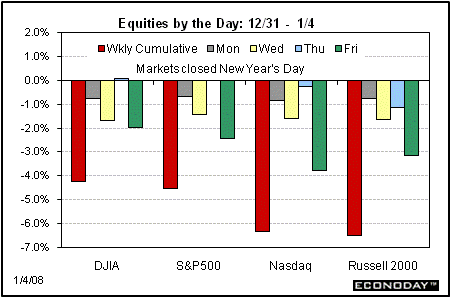
Last week, major indexes were down sharply: the Dow, down 4.2 percent; the S&P 500, down 4.5 percent; the Nasdaq, down 6.3 percent; and the Russell 2000, down 6.5 percent.
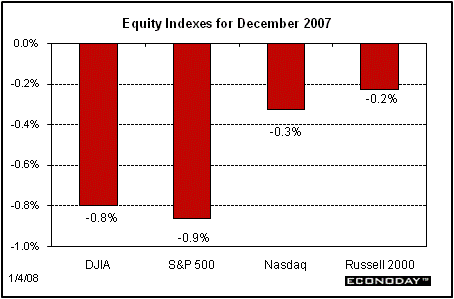
Equities were pulled down slightly the last month of the year with blue chips leading the way. December, major indexes were down somewhat: the Dow, down 0.8 percent; the S&P 500, down 0.9 percent; the Nasdaq, down 0.3 percent; and the Russell 2000, down 0.2 percent.
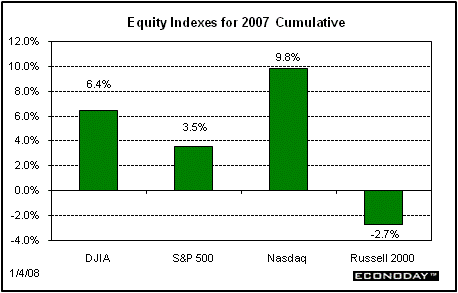
For 2007 overall, most equities posted moderate gains despite problems from a depressed housing sector, higher oil prices, and subprime losses. The Dow hit a record high of 14,164.53 on October 9 but ended the year off the record pace by 6.4 percent. For the year (Dec. 31-over-Dec. 31), the Dow advanced 6.4 percent; the S&P 500, was up 3.5 percent. The S&P 500 was damped somewhat by financials which have a bigger weight in this index compared to the Dow. The tech sector was particularly hot last year as consumers and businesses boosted demand for both electronics and technical services. The Nasdaq gained a healthy 9.8 percent for the year. However, the Russell 2000 lost 2.7 percent in value as small caps suffered the most from flight to safety.
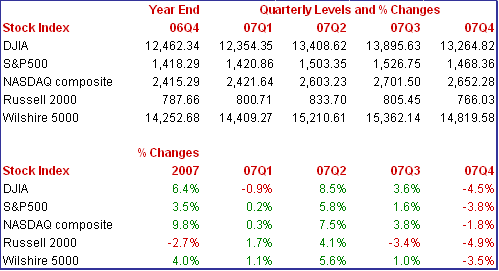
Equities would have had a much better year except for the fourth quarter drop off, largely induced by fears of subprime losses and recession.
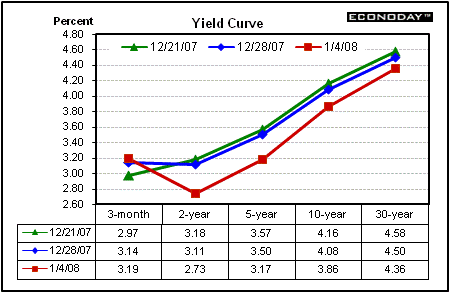
Treasury yields eased last week except on the short end. The mostly negative economic news on existing home sales, the ISM index, and especially the jobs report, boosted Treasury prices while slamming equities. Fears of pending recession clearly weighed on yields.
Treasury yields were down sharply last week except for the near end as follows: the 2-year note; down 38 basis points; the 5-year note, down 33 basis points; the 10-year bond, down 22 basis points; and the 30-year bond, down 14 basis points. The 3-month T-bill edged up 5 basis points over the week.
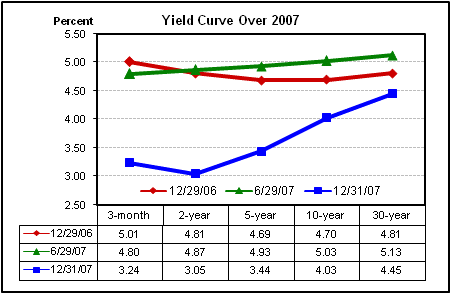
Looking at the year in review, the yield curve started 2007 off slightly inverted with the Fed still maintaining a tight monetary policy. By mid-year, longer rates rose as the economy actually was heating up prior to heading into subprime problems and a credit crunch later in the summer. By year end, Fed easing, economic weakness, and flight to quality from subprime problems pushed rates down, especially on the near end. However, inflation worries kept long rates somewhat elevated.
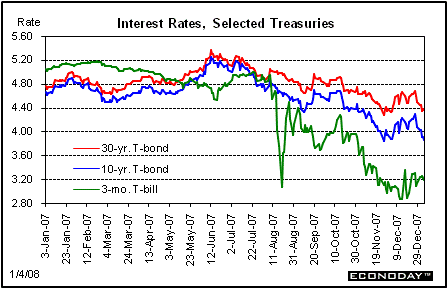
Rates ended the year sharply lower – especially on the near end. But at mid-year, rates had firmed on strong economic growth. Rates began to plummet in late summer as the credit crunch caused flight to quality and also as the Fed cut the fed funds target rate by 100 basis points over the September through December period. Fears of recession also weighed on rates in the latter part of the year.
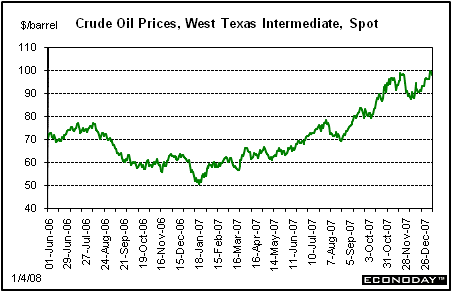
Just when you thought oil prices could not get any higher, oil prices set new record highs. Due to violence in Nigeria, weather curtailing Mexican exports, and low inventories, prices for oil futures traded above $100 per barrel for the first time on Wednesday, January 2 before settling that day at a record $99.62 for spot West Texas Intermediate. Prices eased a little on Friday, dipping $1.27 per barrel after the weak jobs report indicated a weakening economy.
The spot price for West Texas Intermediate rose $1.91 per barrel for the week to settle at $97.91 per barrel, $1.71 below the record high of $99.62 set January 2nd.
For the year overall in 2007, oil prices skyrocketed. West Texas Intermediate spot started the year just under $60 per barrel with the low for the year at $50.30 per barrel on January 18. The high for 2007 was $98.88 on November 22. The year ended at $96.00 per barrel for an increase of 57 percent year-end over year-end.
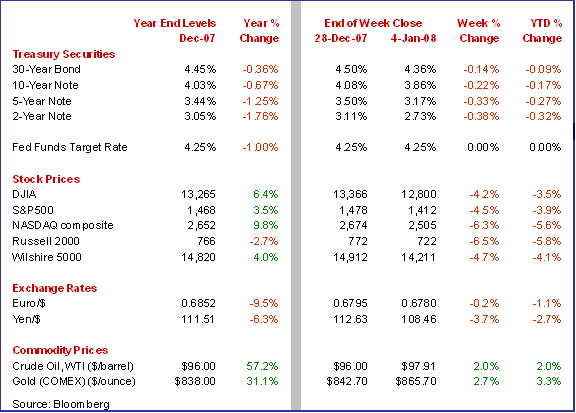
Weekly percent change column reflects percent changes for all components except interest rates. Interest rate changes are reflected in simple differences.
This past week saw more signs of pending recession or at least flat growth. The biggest news was essentially no job growth in December while unemployment jumped. And, unfortunately, wages came in strong and may limit the Fed’s ability to cut rates substantially. Meanwhile, home sales remained depressed while the ISM report pointed to a decline in manufacturing.
While we are not there yet, the December jobs report certainly boosted the credibility of the recession prophets. But the near-term problem is that while employment in December came in very weak, average hourly earnings remained on the high side -- leaving the Fed in a bind as a rate cut to lift jobs could also fuel inflation. Nonfarm payroll employment in December rose only an incremental 18,000. December’s jobs increase was the weakest since a 42,000 decline for August 2003.
The initial November estimate of a 94,000 increase was revised up 21,000 and October was revised down 11,000 from the previous estimate of a 170,000 increase. For November and October combined, the net revision was up 10,000. Weakness was primarily in the construction and manufacturing sectors although services were mixed with some components declining.
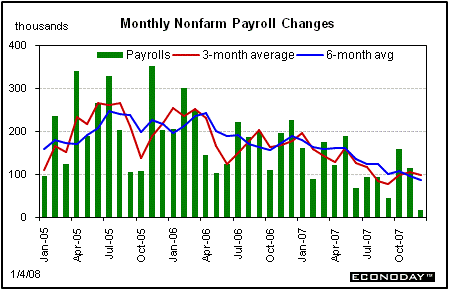
Within the payroll survey, weakness was in the goods-producing sectors. Manufacturing fell by 31,000 in December, following a 13,000 decline in November. Construction continues to spiral downward, reflecting the recession in housing. Construction jobs fell 49,000 in December after a 37,000 decline the prior month. Natural resources & mining rose by 5,000 in the latest month.
The service-providing sector provided some strength in December, rising 93,000, following a 160,000 gain in November. But this sector was mixed with gains led by education & health services, professional & business services, government, and leisure & hospitality. Declines were led by retail trade and by information industry employment.
While the overall gain of 18,000 in December was mildly positive and helps to keep the economy out of recession by definition, that may not hold true when payroll numbers are revised later in the year. Earlier estimates for employment heavily depend on how the Labor Department estimates “births” and “deaths” of businesses during the year. Typically, the Labor Department underestimates net growth in business establishments when the economy is coming out of recession and overestimates when slowing down or declining. Hence, there is a good chance that when payroll data are revised this summer that December was a mildly negative number for payroll employment.
The worrisome news for the Fed is that on the inflation front, average hourly earnings growth remained high with a 0.4 percent gain in December, matching the boost in November. Year-on-year, average hourly earnings stood at 3.7 percent in December, down marginally from 3.8 percent in November.
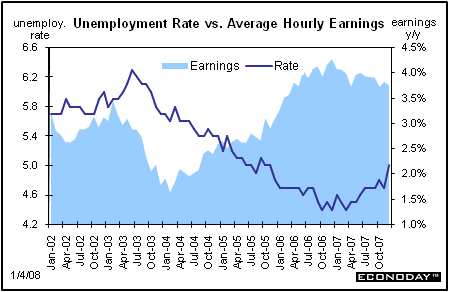
And the labor market may be loosening a bit according to the household survey. The civilian unemployment rate rose to 5.0 percent from 4.7 percent in November. Household employment dropped 436,000 in December, following a 631,000 surge the prior month. The labor force rose by 38,000 in December, while the number of unemployed increased 474,000. December’s 5.0 percent unemployment rate is the highest since the same rate in October 2005.
The bottom line is that the latest jobs report puts the Fed in a tough situation. The economy may be weakening faster than the Fed's liking while employment costs are on still on the high side.
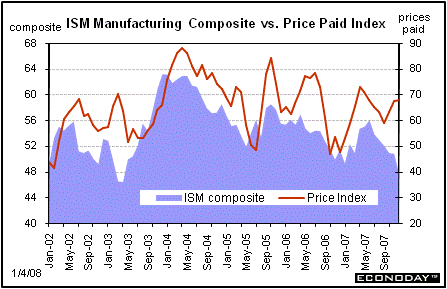
The December jobs report was not the only indicator raising recession worries. Manufacturing slumped badly in December, at an index of 47.7 for a 3.1 point decline from November and the lowest reading since early in the current expansion. A sub-50 reading, the first in a year, indicates that responses were more negative than positive. The weakness is alarming because it is centered in orders with new orders at a very low 45.7 vs. 52.6 in November and backlogs, which in October began to signal weakness, at 43.0. The order readings, with odd exceptions for backlogs, are the weakest since 2003. New export orders are still above 50, at 52.5 but posted a stinging 6 point decline.
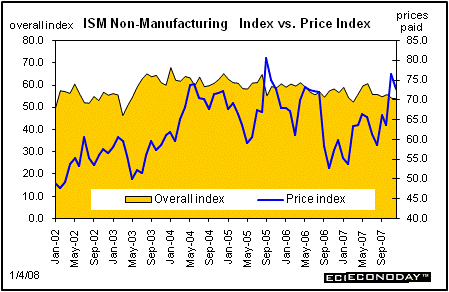
The only really positive economic news last week was the ISM non-manufacturing survey. The jobs report may be pointing to a hard slowdown but not the ISM non-manufacturing report which offers a reminder that economic growth is still alive. The ISM non-manufacturing index slipped in December to 53.9 but remained notably above the breakeven point of 50. Even the employment index showed strength, up 1.3 points to 52.1.
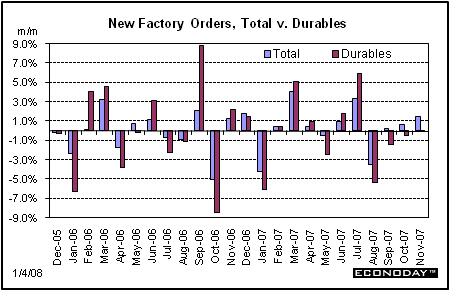
At face value, factory orders would suggest that manufacturing is not yet in trouble. But a peak at the detail suggests otherwise. Factory orders jumped 1.5 percent in November but the gain was largely related to a surge in oil prices. The November increase in orders reflected a 3.0 percent spike in orders for nondurable goods, a category bloated by price related gains for energy products. But the more realistic story comes from orders for durable goods which slipped a revised 0.1 percent for the month. Inventories offer more signs of trouble, jumping 0.8 percent overall. Some of this was price related but even inventories for durables jumped 0.7 percent.
The good news is that the bleeding in existing home sales did not worsen in November. The bad news is that sales are still depressed and with heavy overhang in supply. Existing home sales edged up 0.4 percent to a 5.00 million annual rate. But the sales pace is the second lowest in the nine years of the current series. The year-on-year rate is still down a whopping 20 percent.
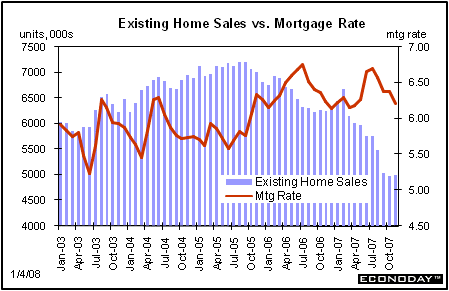
Supply on the market slipped to 10.3 months from 10.7 months but is still bloated. Prices remain firm as the median price rose 1.6 percent to $210,200, down only 3.3 percent year-on-year. However, the median price is likely holding up only due to relatively heavier weakness in sales on the low end. That is, sales activity is holding up better in high end homes.
So, where do the latest economic data leave the Fed' Should the Fed worry more about recession or more about too-high inflation' The latest FOMC minutes give some guidance on the Fed’s leanings. The minutes of the FOMC meeting held on December 11 indicate that members see the economy as unusually uncertain, but this past week’s data will have the FOMC likely more concerned about recession than inflation. Members viewed economic data since the October meeting as weaker than expected and resulted in a lowering of the Fed’s forecast for economic growth. This and a reemergence of financial instability were the reasons for lowering the fed funds target rate by another 25 basis points. The FOMC was not more aggressive due to the belief that the prior 75 basis point reduction would continue to operate with a lag — with the full impact still to come. The FOMC participants saw headline inflation rising in the near-term due to higher food and energy costs. But with futures prices pointing toward lower oil costs and with resource utilization easing, inflation was expected to come down both at the headline and core levels.
While recent and weak economic data point toward another rate cut on January 30, the key toward the length and depth of rate cuts is the stabilization of credit markets. Committee members saw that credit problems could move in either direction over the next few months. The credit markets were seen as either worsening or possibly correcting faster than anticipated and result in the need to reverse some of the recent interest rate cuts.
“Some members noted the risk of an unfavorable feedback loop in which credit market conditions restrained economic growth further, leading to additional tightening of credit; such an adverse development could require a substantial further easing of policy. Members also recognized that financial market conditions might improve more rapidly than members expected, in which case a reversal of some of the rate cuts might become appropriate.”
Certainly, the latest jobs numbers and rise in unemployment will lead to at least one more rate cut. But if the credit markets stabilize soon, the Fed could consider nudging rates back up even before year end if inflation pressures are unacceptable. The Fed has less room currently to rev the economy than it did coming out of the mild 2001 recession.
On a final Fed note, this year brings in the usual rotation of Fed regional presidents to be voting FOMC members. Two inflation hawks are in the voting lineup -- Philadelphia Fed President Charles Plosser and Dallas Fed President Richard Fisher. This change in the FOMC votes is likely to limit how far the Fed will go with interest rate cuts.
The economy is slowing substantially. While housing may have hit bottom, now manufacturing is softening or even declining. And a flat jobs report indicates that the consumer cannot keep the economy at a strong pace for now. While the data do not yet indicate we are in recession, it is clear that we are in a soft patch to borrow a phrase from some of recent months’ Fedspeak. Where is momentum carrying the economy' A key factor is that the recent 100 basis point cut in the fed funds target rate has yet to fully kick in. Also, the Fed is likely to cut rates again on January 30. Overall, the economy is likely to be near flat for one or two quarters and technically miss recession. For the first half of 2008, one should expect weak equities overall but perhaps a rebound late in the year.
This coming week has a very light schedule for economic indicators. There is only one major indicator with the international trade deficit out on Friday. But markets also will be giving initial claims a little more attention, looking for signs of recession or not. Also, the import prices report on Friday will be an inflation report that leads into the following week’s PPI and CPI reports.
Consumer credit rose $4.7 billion in October, up from a $3.2 billion increase in September. Constraints on home equity credit continue to push consumers to their credit cards as revolving credit rose a sizable $6.4 billion vs. a $4.5 billion increase in September. The annual rate of increase in this category is in the high single digits, beyond the mid single digit gains for retail sales. With delinquency rates rising, markets and the Fed may be giving consumer credit data more attention than in recent months.
Consumer credit Consensus Forecast for Nov 07: +$9.0 billion
Range: +$4.0 billion to +$11.0 billion
Initial jobless claims fell 21,000 in the week ending December 29 to 336,000, pulling down the four-week average slightly to a still elevated 343,750. The Dec. 22 week was revised upward to 357,000 for the highest level in more than two years. While claims have been trending upward, thus far they appear to point to a very soft economy but not yet to a declining economy. Markets will continue to watch the claims data for early warnings of potential recession, but volatility in the data will remain an issue.
Jobless Claims Consensus Forecast for 1/5/08: 340,000
Range: 325,000 to 345,000
The U.S. international trade gap widened in October to $57.8 billion from $57.1 billion in September. The worsening was primarily due to a jump in oil imports. But exports continued to grow, setting a record high in October. With recent gains in oil prices, overall imports are likely to be up notably and will likely lead to a wider trade gap and put downward pressure on the dollar. Nonetheless, markets should closely watch the export component to see if U.S. manufacturing is continuing to get support from foreign demand.
International trade balance Consensus Forecast for November 07: -$58.6 billion
Range: -$64.0 billion to -$58.0 billion
Import prices surged 2.7 percent in November for a year-on-year rise of 11.4 percent. The monthly increase was the largest in 17 years. Most of the spike came from oil and natural gas prices. Import prices excluding petroleum also rose sharply, up 0.7 percent in the month for a 3.0 percent year-on-year increase. We are likely to see more of the same for December, given recent gains in oil prices and downward trend in the dollar.
Import prices Consensus Forecast for December 07: 0.0 percent (flat)
Range: -0.8 to +1.5 percent
The U.S. Treasury monthly budget report showed a November deficit of $98.2 billion versus a November 2006 deficit of $73.0 billion. But the Congressional Budget Office said $17 billion of transfer payments, due to a calendar quirk, were pulled into November from December. Looking ahead, the month of December typically shows a modest surplus for the month. Over the past 10 years, the average surplus for December has been $13.9 billion.
Treasury Statement Consensus Forecast for December 07: +$50.0 billion (surplus)
Range: +$36.0 billion to +$64.0 billion.
|

![[Econoday]](images/econoday_logo_slim.gif)
![[Econoday]](images/logo.gif)
 <% if ((ihtmlinclude AND 65536) = 65536) then %>

